



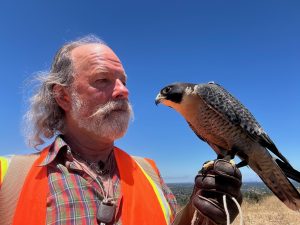
[Photo: Kenny on the job with his helper, Gauge, the Anatum Peregrine]
Here at the Los Gatos Birdwatcher, we spend a lot of time watching and celebrating birds. But there’s another, lesser-known way humans interact with birds—working alongside them. We spoke recently with Kenny Elvin of Full Circle Falconry and Wildlife Conservation, a falconer who has spent the last 25 years working alongside birds of prey. His career combines wildlife management, education, and the ancient practice of falconry—a lifestyle that requires dedication, patience, and respect for the wild.
What Is Falconry?
“Falconry is hunting,” Kenny explains. “You need both a hunting license and a falconry license. It’s not casual because you commit your life to these animals.” Unlike pets, raptors are never domesticated. Falcons and hawks already know how to fly and hunt. The falconer’s role is to build a working relationship based around the bird’s natural instincts.
“You’re not teaching them how to be birds. You’re stepping into a natural process.” In Kenny’s view, falconry is less about control and more about partnership. The experience changes both bird and human. “You’re building relationships with these animals. It changes us and our attitudes and behaviors as much as the birds change.”
Using Nature to Solve Human Problems
One of Kenny’s primary jobs is falconry abatement—the use of trained raptors to help manage bird populations where humans and wildlife come into conflict. Think shopping centers overrun by crows, agricultural sites dealing with large numbers of birds feeding on crops, and landfills filled with gulls. Instead of using chemicals or traps, applying a natural predator-prey relationship becomes the solution.
“We use the presence of a predator in the sky to encourage birds to move along,” he says. “The goal isn’t elimination. It’s a redistribution.” Kenny applies consistent exposure of the predator day after day or night after night. When the birds disperse, Kenny’s work continues with regular site monitoring. His work often involves both birds and dogs working together to create a safe, humane solution.
Meet the Team
Kenny currently works with an impressive crew that includes an Aplomado Falcon, three Peregrine Falcons, three Harris’s Hawks, a Barn Owl, and two hard working dogs named Jasper and Regina. Each species has its own specialty. Peregrine Falcons are famous for speed and are particularly effective at dispersing pigeons and gulls. Harris’s Hawks, often called “wolves of the sky,” are unusual among raptors because they naturally hunt cooperatively and excel at flushing birds from dense cover. Having multiple birds allows Kenny to rotate individuals, match birds to specific jobs, and keep them healthy and motivated.
The Reality Behind the Romance
Falconry often sounds glamorous, but the reality is demanding. “You might be checking a site at 1:30 AM and then working from before sunrise until after sunset,” Kenny says. It’s a seven-day-a-week commitment. Falconers are responsible for every aspect of their birds’ care, conditioning, housing, and health. And because the birds remain wild at heart, there are no guarantees. Kenny says, “They may fly off. They may be injured by another raptor. There can be sickness. You never really get used to it. But you accept it.”
A Falconer Wears Many Hats
Kenny’s work is more layered than most people expect. Along with keeping a bird healthy and fit, Kenny explains that “keeping a bird keen and paying attention to you are the keys to falconry. Falconry birds need to be in top condition. Both dogs and birds work best with consistent routine and fitness.”
Here are some of the many roles a falconer takes on::
-
Abatement Work – Using trained raptors to shift bird populations in places where they’ve become overwhelming using a “biological predator-prey relationship strategy. Working with nature; not against it.”
-
Falconry (Hunting) – At its core, falconry is the traditional practice of hunting with a raptor. It requires licensing, skill, and a deep understanding of each bird’s instincts.
-
Educational Work – Through bird shows and public programs, Kenny gives people the opportunity to see raptors up close often changing how they feel about birds of prey.
-
Dog & Bird Training – Conditioning both dogs and birds to work safely and effectively together. “It’s a lot like being a personal trainer,” he says, “Building trust, focus, and endurance over time.”
Sharing Raptors With the Public
Kenny brings birds into public spaces like community events and educational programs. For many people, it’s their first opportunity to see a bird-of-prey up close. And yes, occasionally one of his birds lands on a spectator’s head. “Most people are okay with it,” he laughs. Sometimes nature adds more unexpected surprises. During one presentation, just as the program ended, someone in the audience pointed skyward and asked, “Is that a Bald Eagle?” It was! “Just cruising through,” Kenny says. Perfect timing.
Not for the Casual Curious
For anyone interested in becoming a falconer, Kenny offers a word of caution. “We try to talk people out of it.” Not because falconers are secretive, but because the commitment is enormous. In the United States we need to pass an exam to become an apprentice. Apprenticeship is a minimum of two years to become a general falconer. A falconer’s license must be renewed yearly. The California Hawking Club website offers a guide for aspiring falconers. “It’s not something you do on weekends,” Kenny says. “It’s a lifestyle.”
A Life Connected to Nature
When he’s not working with birds, Kenny enjoys surfing, Renaissance Faires, building equipment for his raptors, and foraging with his wife, Kitty. The couple has been together for 40 years and shares a lifelong love of the outdoors. The couple’s daughter has followed a similar path and now works as a nature educator. For Kenny, all of these pursuits stem from the same place: a desire to stay connected to the natural world. “I try to live my best life,” he says. “When there’s a swell, I surf.”
Looking Closer
At the Los Gatos Birdwatcher, we know falconry can spark mixed feelings. For some people, the idea of capturing and working with raptors can feel at odds with the joy of observing birds freely in the wild. Kenny doesn’t shy away from that tension. “In the wild, there’s constant pressure to survive,” he says. “Being with a falconer, there’s less pressure on the bird to survive—but we still need them in peak condition. We’re responsible for their health.”
Kenny emphasizes three key principles of falconry:
-
“These birds are not domesticated. They retain their instincts and independence.”
-
“The birds’ care requires extensive knowledge, vigilance, and lifelong commitment.”
-
“The birds’ work often supports more balanced ecosystems in human-altered spaces.”
Conversations with people like Kenny remind us that there are many ways humans connect with wild birds. Whether you’re watching orioles return each spring, feeding birds in your backyard, or learning about falconry, there are many ways to connect to the natural world. Sometimes connection begins with a pair of binoculars. Sometimes it begins with a hawk on a glove. Either way, it invites us to look a little closer.